


Obama nungara
Obama Nungara
 Print Page
 Send Via Email
Overview
Photo credit: Hugh Jones, Scientific Associate, Natural History Museum, London.
Obama nungara
Habitat:
Description:
Origin and Distribution:
Impacts:
Is it found in Northern Ireland?
How could it get here?
You can help by reporting any sightings: @ the Centre for Environmental Data & Recording (CEDaR) - Or via the iRecord App.
Prevent Spread
Current Legislation Position (Listed on 07 August 2025): This species must not intentionally be brought into the Union; kept; bred; transported to, from or within the United Kingdom, unless for the transportation to facilities in the context of eradication; placed on the market; used or exchanged; permitted to reproduce, grown or cultivated; or released into the environment.
For further queries, you can contact the Invasive Non Native Species (INNS) Team in the Northern Ireland Environment Agency on 028 9056 9558 or Email: invasivespecies@daera-ni.gov.uk
Obama nungara
Habitat:
- Around freshwater rivers, lakes and wetlands
- Areas of soft, sandy or muddy substrate
- Also found in human disturbed areas, such as parks and gardens
Description:
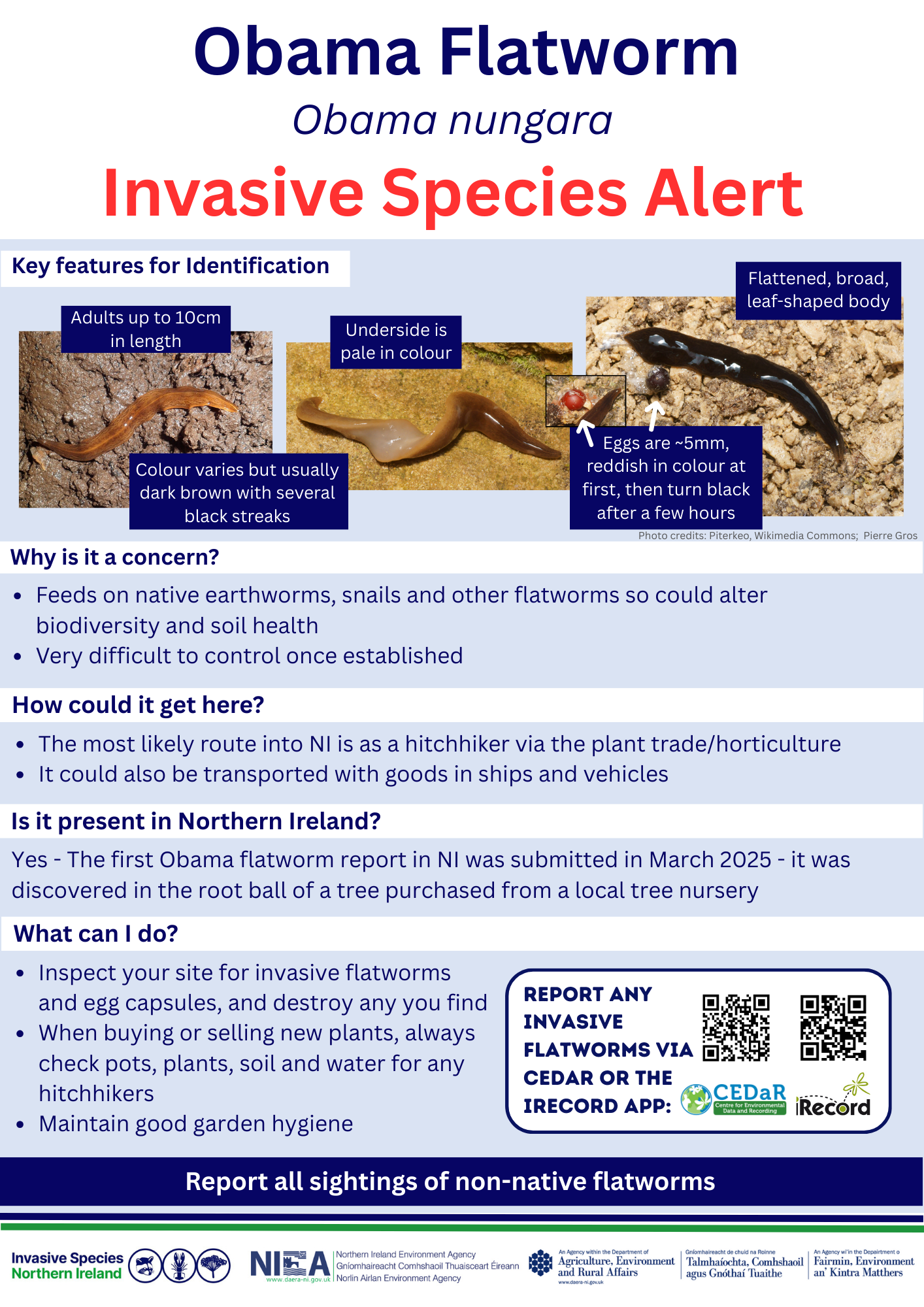
- 10cm in length 1cm in width
- Broad leaf-shaped body
- Dark brown with black dorsal streaks
- Colour ranges from very dark-mid brown with occasional pale midline
- Ventral side is pale
- Has many black eyes around the head and sides but are difficult to spot
- Lays 5mm cocoons which are black and take a few weeks to hatch
Origin and Distribution:
- Native to South Brazil and Argentina
- Scattered distribution in the UK
- Also found in Guernsey, Jersey, Belgium, France, Spain, Ireland, Italy, Portugal, Maderia and the Azores
- Distribution is mainly linked to climate
Impacts:
- Feeds on native earthworms, snails and other flatworms changing the biodiversity
- Hard to get rid of so can easily spread
Is it found in Northern Ireland?
- One report in Northern Ireland but they are found in Ireland
How could it get here?
- Transported with goods in ships and vehicles
- Main route of invasion is through the plant trade
You can help by reporting any sightings: @ the Centre for Environmental Data & Recording (CEDaR) - Or via the iRecord App.
Prevent Spread
- Report all sightings
- Do not bring this species into Northern Ireland
- Inspect incoming consignments of plants
- Don't accept plants from areas where the Obama flatworm is present, as this can aid their spread
- Maintain good garden hygiene
- Inspect your site for flatworms
- Destroy immediately if you detect them (see flatworm control)
Current Legislation Position (Listed on 07 August 2025): This species must not intentionally be brought into the Union; kept; bred; transported to, from or within the United Kingdom, unless for the transportation to facilities in the context of eradication; placed on the market; used or exchanged; permitted to reproduce, grown or cultivated; or released into the environment.
For further queries, you can contact the Invasive Non Native Species (INNS) Team in the Northern Ireland Environment Agency on 028 9056 9558 or Email: invasivespecies@daera-ni.gov.uk